
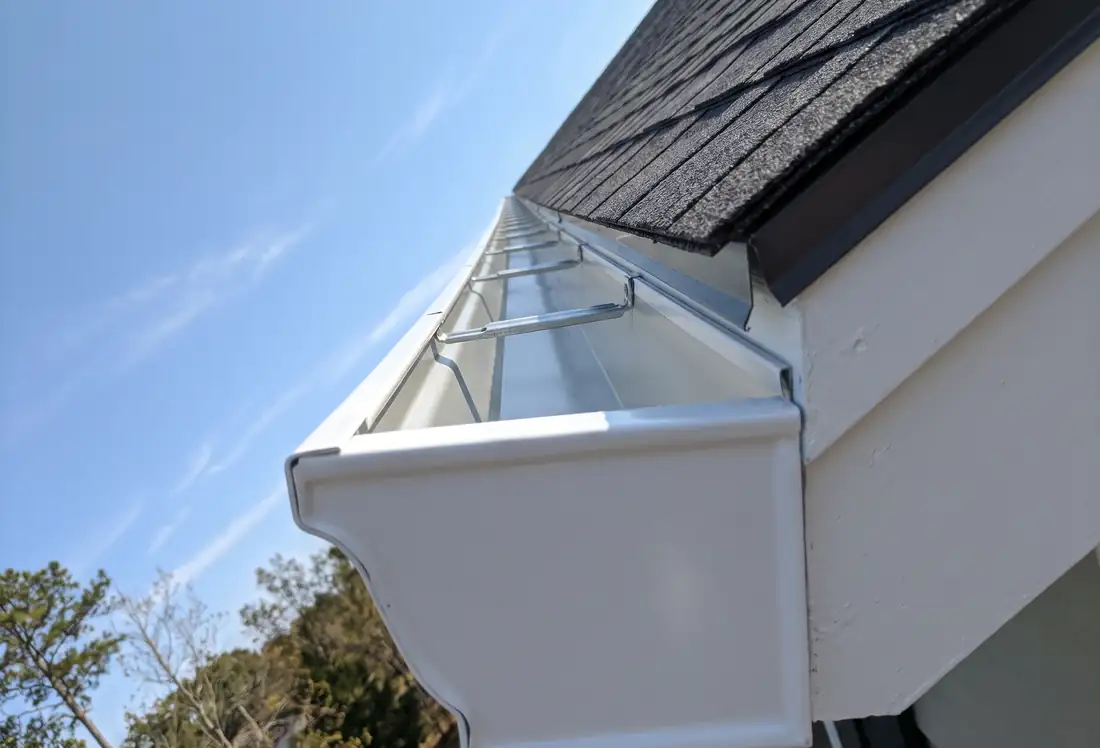
What causes a sag
| Cause | Sign | Fix |
|---|---|---|
| Spikes working loose | Spike heads backed out of the gutter face | Replace with screwed hidden hangers |
| Hangers too far apart | Droop between each hanger | Add hangers at closer spacing |
| Soft fascia | Screws spin; wood crumbles when probed | Replace the board, then rehang |
| Wet debris load | Sag where leaves and straw collect | Clean, rehang, consider guards |
| Limb strike | Run bent at one point | Replace the length if kinked |
| Ladder damage | Dent and kink at one spot | Replace the length |
Weight and wind
A 5-inch gutter full of water weighs a lot per foot, and in a Baton Rouge downpour it fills quickly. Add wet leaves and pine straw, and spikes every 3 or 4 feet start to give way in the middle of long runs. Once a sag starts, it holds more water and debris, and it gets worse. Then hurricane season adds wind, which lifts a loose gutter from below.
When a run is rehung, the contractor should:
- use screwed hidden hangers that tie the front lip to the back,
- space them about every 2 feet,
- set the back of the gutter under the drip edge,
- re-pitch about a quarter inch per 10 feet so the trough drains between storms.
Fascia first
A hanger is only as good as the wood behind it. Fascia behind a leaking or overflowing gutter often rots along the bottom edge, and in south Louisiana it is worth checking for termite damage too. Any soft wood is cut out and replaced before the gutter goes back up. See fascia and soffit.
Common mistakes to avoid
- Driving spikes back in rather than switching to screwed hidden hangers.
- Rehanging on soft fascia.
- Forgetting to re-pitch, so the run still holds water.
- Leaving the debris that caused the sag in place.
In Baton Rouge and the Capital Region
Sags are common on builder-grade gutters in St. George, Prairieville, Zachary and Central, and on spike-hung gutters on older homes everywhere, especially under trees.
When to do it
Before hurricane season. A sagging run is the first thing wind tears off.
What to ask before you agree
Ask what hangers will replace spikes, the new spacing, and whether the fascia will be checked.
Why rehanging beats patching
Pushing a sagging gutter back up and driving the spike in again lasts a season at most. The spike has already enlarged its hole in the wood, and the next full trough or gust pulls it out again. A proper repair replaces spikes with screwed hidden hangers, adds hangers where spacing was too wide, and sets the pitch so the run drains fully between storms.
Where sags start
Sags usually start in the middle of long runs, under the biggest trees, and on runs below valleys where water and debris collect. If one section sags, check the whole house; the same hangers were used everywhere.
Related
See leaking gutters, gutter guards and gutters and hurricanes.