
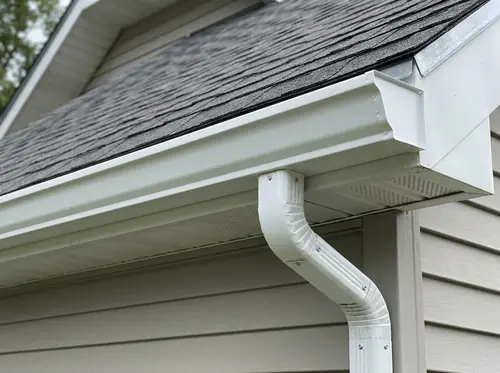
Where gutters leak
| Location | Usual cause | Fix |
|---|---|---|
| Inside or outside corner | Sealant split; rivets loose | Clean to bare metal, re-rivet, reseal |
| End cap | Sealant failed | Reseal or replace the cap |
| Outlet | Seal around the drop failed | Reseal or replace the outlet |
| Along a seam on sectional gutters | Connector sealant failed | Reseal, or replace with seamless |
| Behind the gutter | No drip edge, or gutter pulled from fascia | Add drip edge, rehang |
| Over the front | Blocked outlet or bad pitch | Clear, re-pitch, add downspout |
Why leaks matter more here
A drip at a corner runs onto the same piece of fascia in every storm. In a climate with about 62 inches of rain and long, humid summers, that wood rarely dries out. Paint fails, mildew grows, the board softens from the back, and moist wood is what the Formosan subterranean termite looks for. A leak that costs little to fix can mean fascia replacement and a termite inspection later.
How a proper reseal is done
- Clean the joint of all old sealant, dirt and oxidation, down to bare metal.
- Dry it thoroughly.
- Re-rivet if the joint has moved.
- Apply a gutter sealant made for aluminum, worked into the seam.
- Let it cure before water runs over it.
Leaks that come back
If a corner leaks again within a year or two, look at why water is sitting there:
- The run is pitched away from the outlet, or has sagged.
- The outlet is partly blocked by leaves, catkins or pine straw.
- The gutter has pulled away from the fascia and is flexing.
Common mistakes to avoid
- Smearing new sealant over old without cleaning to bare metal.
- Sealing on a damp day and expecting it to last.
- Fixing the drip but not the sag that keeps water at the joint.
- Ignoring water behind the gutter until the fascia rots.
In Baton Rouge and the Capital Region
Leaks are most common on older sectional gutters, on corners sealed in a hurry after the 2016 flood, and on runs that sag under trees.
When to do it
Reseal on a dry day, ideally before the spring and summer storms.
What to ask before you agree
Ask whether corners will be cleaned to bare metal, what sealant is used, and whether pitch and hangers will be checked at the same visit.
Finding the leak
Leaks are easiest to find in the rain or with a hose. Run water into the gutter at the high end and watch from the ground:
- A steady drip at a corner or end cap means failed sealant.
- Water running down the back of the gutter onto the fascia means a missing drip edge or a gutter pulled away from the house.
- Water pouring over the front at one spot means a blockage, a sag or a pitch problem.
- Water appearing at the bottom of a downspout joint means a blocked drain line.
Related
See sagging gutters, fascia and soffit and gutters, termites and wood rot.