
On this page
- Baton Rouge's first subdivision
- Garden District houses
- Under the oaks
- Old trim, careful work
- What Garden District gutters usually need
- Timing gutter work in the Garden District
- Checking a contractor in the Garden District
- Around the Garden District
- What this means for gutters in the Garden District
- Questions to ask a contractor in the Garden District
- Gutter checklist for the Garden District
- Common gutter mistakes in the Garden District
- A typical job in the Garden District
- Rain and storms in the Garden District
- Nearby
| City | Baton Rouge, East Baton Rouge Parish |
| Zip code | 70806 |
| Setting | Mid City, where Park Boulevard meets Government Street |
| History | Roseland Terrace, the city's first subdivision, staked out in 1911 (Wikipedia) |
| Character | Boulevards lined with live oaks, magnolias and azaleas (APA) |
| Biggest gutter risks | Oak leaves and catkins, old fascia, limbs |
Baton Rouge's first subdivision
The Garden District is really three historic districts: Roseland Terrace, Drehr Place and Kleinert Terrace. Roseland Terrace, staked out in 1911 on a former racetrack, was the city's first subdivision and an early example of a garden suburb, with small lots, trees along streets and alleys, and utility poles kept to the alleys. The American Planning Association named the Garden District one of its Great Places in 2012, noting live oaks individually registered with the Live Oak Society and medians lined with oaks, magnolias and azaleas.
Garden District houses
| House type | Typical gutters | What to watch |
|---|---|---|
| 1910s to 1920s bungalow | Half-round or small K-style | Rafter tails; old fascia |
| Cottage | K-style or half-round | Low eaves under big oaks |
| Two-story revival house | K-style or half-round, tall downspouts | Height; access |
| Renovated house with addition | Mixed systems | Old and new gutters joined |
Under the oaks
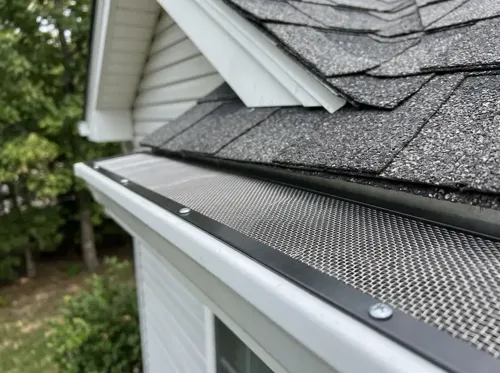
Live oaks are among the most wind-resistant trees in Louisiana, but they are messy. Each spring they drop the previous year's leaves along with catkins and pollen, and the Garden District's canopy is dense. Gutters here need a clean in late spring and often again in fall. Fine stainless micro-mesh keeps most of it out.
Old trim, careful work
Many bungalows have exposed rafter tails and original wood trim. Before new gutters go up, the fascia and rafter ends should be probed and soft wood replaced. On houses without a continuous fascia, roof-strap brackets for half-round may be the right method.
What Garden District gutters usually need
| Job | Why it comes up here | Page |
|---|---|---|
| Half-round gutters | Bungalows | Half-round gutters |
| Guards | Heavy live oak canopy | Gutter guards |
| Fascia repair | Old trim | Fascia and soffit |
| Storm repairs | Limbs | Storm damage |
Timing gutter work in the Garden District
Most full installations here happen from fall through early spring, when crews are less busy and afternoons are not interrupted by thunderstorms. Book cleaning for late spring, after the oaks finish dropping, and again before the peak of hurricane season in August and September. After a named storm, a contractor can usually make a loose run safe quickly and come back for the full repair once roofs and trees are dealt with.
Checking a contractor in the Garden District
- Licensing. Home improvement jobs over $7,500 need an LSLBC home improvement registration; larger residential jobs a residential license. Check on the contractor search.
- Insurance. Ask for a certificate of liability insurance.
- Paperwork. Get a written quote with sizes, materials, downspouts and warranty.
- Door-to-door sales. A contract signed at your home usually comes with a three-day right to cancel under the FTC's Cooling-Off Rule.
Around the Garden District
Work covers Roseland Terrace between Government Street, South 18th, Myrtle and South 22nd, Drehr Place along Drehr Avenue, and Kleinert Terrace between Myrtle, Perkins Road and Broussard.
What this means for gutters in the Garden District
The Garden District's live oaks are its glory and its biggest gutter problem. Each spring they shed the previous year's leaves, along with catkins and pollen, and a bungalow under two big oaks can fill its gutters in a few weeks. Outlets jam, water pours over the front onto porches and beds, and wet debris holds moisture against old wood trim.
The usual work here combines care and capacity: replacing soft fascia and rafter ends, hanging half-round or modest K-style gutters that suit the bungalows, upsizing outlets and downspouts so leaves pass through, and fitting fine micro-mesh guards screwed to the gutter. Before storm season, an arborist's look at limbs over the roof is worth the cost; the LSU AgCenter advises removing branches that touch the roof.
Questions to ask a contractor in the Garden District
- Have you hung half-round on houses with exposed rafter tails?
- Will you repair original trim, and how will you match it?
- Which guard do you recommend under live oaks, and how is it fastened?
- Can you add drip edge without disturbing the roofing?
- Will you check for termite signs when the old gutters come down?
Gutter checklist for the Garden District
| What to check | Why it matters here |
|---|---|
| Outlets and downspouts | Oak leaves and catkins jam 2x3 downspouts in spring |
| Hanger spacing | A trough full of wet leaves and storm water is heavy |
| Trees over the roof | Limbs fall in squalls and hurricanes |
| Spring pollen | Films guards and gutters in March and April |
| Fascia and rafter tails | Decades of drip rot the wood |
| Drip edge | Many older roofs never had it |
Common gutter mistakes in the Garden District
- Skipping the late-spring cleaning after the oak drop.
- Leaving 2x3 downspouts under heavy oak canopy.
- Hanging new gutters on soft fascia.
- Wrapping rotten or termite-damaged trim in aluminum.
A typical job in the Garden District
Take a house under two big live oaks. A good contractor would usually:
- Clean and flush all gutters and downspouts after the spring drop.
- Rehang sagging runs on screwed hidden hangers about every 2 feet.
- Upsize the busiest downspouts to 3x4.
- Fit stainless micro-mesh guards.
- Water-test every run.
The price depends on the house, but a written quote should list each of these steps, the materials and the warranty.
Rain and storms in the Garden District
Baton Rouge averages about 62 inches of rain a year, and its wettest month on record, August 2016, brought 30.96 inches. Hurricane Gustav in 2008 brought winds over 100 mph to the city, and Ida in 2021 closed more than 85 roads in the parish with fallen trees and lines. For gutters in the Garden District, that means three things: enough capacity for intense rain, hangers that hold in wind, and a plan for the trees over the roof.
| Factor | What to do |
|---|---|
| Intense summer storms | 3x4 downspouts, outlets near valleys, 6-inch where needed |
| Hurricane wind | Screwed hidden hangers about every 2 feet; strapped downspouts |
| Big trees | Guards, regular cleaning, limbs off the roof |
| Flat ground | Extensions or drain lines away from the slab |
Nearby
Mid City · Downtown · Southdowns · College Town · Goodwood