
On this page
When 5-inch is not enough
| Factor | Why it matters |
|---|---|
| Large roof planes | More area draining to one gutter |
| Hip roofs | Water arrives at every side and every corner |
| Steep pitch | Water moves faster and can overshoot a small gutter |
| Valleys | Two roof planes pour into one spot |
| Few downspouts | Each outlet drains a longer run |
| Cloudbursts | Summer storms can drop inches in an hour |
Baton Rouge rain is intense
The annual total, about 62 inches, is high on its own. What tests gutters is how it falls. Thunderstorms in summer and tropical systems in late summer and fall can drop a month's rain in a day. In August 2016, Baton Rouge recorded 11.24 inches in a single day as the great flood began. No gutter carries that without overflowing, but a gutter sized for ordinary storms should not overflow in every afternoon thunderstorm.
6-inch or more downspouts?
Adding a downspout halves the length each outlet drains, which can be enough on a one-story house. On a two-story house with a steep hip roof, the gutter may already be overflowing at the valley before water reaches an outlet. Then the bigger gutter is the fix.
Downspouts that go with 6-inch
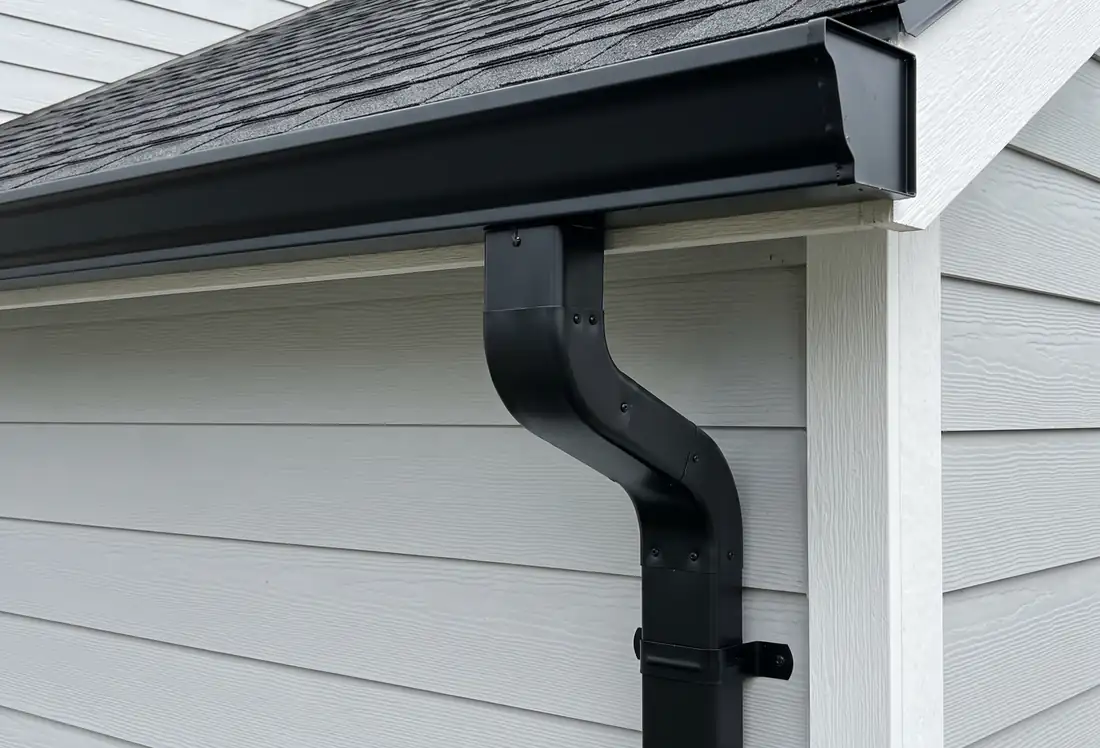
A 6-inch gutter is usually paired with 3x4 downspouts. The bigger pipe carries roughly twice the water of a 2x3 and lets leaves and pine straw pass more easily. Where a downspout connects to a buried drain line, check that the line itself is big enough and clear.
Common mistakes to avoid
- Going up to 6-inch but keeping 2x3 downspouts, which then become the bottleneck.
- Fitting 6-inch to cure an overflow that is really a blocked outlet or a sag.
- Joining 6-inch and 5-inch at a corner without a proper transition, which leaks.
- Sending more water to the slab instead of away from it.
In Baton Rouge and the Capital Region
The houses that most often need 6-inch are large two-story homes with hip roofs and valleys in St. George, Prairieville, Highland Road, the Country Club of Louisiana and Oak Hills Place. Brick ranches in Broadmoor and Sherwood Forest rarely do.
When to do it
Watch your gutters in a summer storm. If they overflow when clean, plan the change for fall or winter.
What to ask before you agree
Ask which runs need 6-inch and which do not, what size downspouts come with them, and whether existing drain lines can carry the extra flow.
How a contractor decides
A good contractor looks at each run, not just the house. The questions are how much roof drains to that run, how steep it is, whether a valley empties onto it, and how many outlets it has. Often only the runs below valleys on the main roof need 6-inch, while porch and garage runs stay 5-inch.
Testing before you buy
Watch the gutters in a heavy afternoon storm with them freshly cleaned. Water pouring over the front of a clean gutter, especially at a corner below a valley, points to capacity. Water spilling only at one low spot points to pitch or a sag. Water bubbling at the bottom of a downspout points to a blocked drain line.
Related
See 5-inch vs 6-inch gutters, overflowing gutters and downspouts.